What Else? – Experiment
I built a Figma plugin that asks the question I forget to ask.
What Else? reads your finished screens, finds the states you probably missed, and draws them with your own components. Six designers tested it, and 73 of the 87 screens it made were kept.
- states generated
- of them kept
- average rating, out of 10
- would use it again
- Role
- Product designer, researcher and builder
- Type
- Independent exploration
- Timeline
- 10 days, 5 versions
- Tested with
- 6 product designers
The confession
I have shipped a form without a loading state. More than once.
Not because I didn’t know loading states exist. I could draw you one in my sleep. The problem is that by the time I finish the happy path, my brain thinks the screen is done.
The empty state, the error state, the “what if this takes eleven seconds” state all live in a part of my head that only switches on in review, usually when a developer asks, “what happens here?” So I wondered: what if the design file could ask me that question first?
What it does
Five steps, and your originals are never touched.
- 01
Select your frames
One or more, mobile or web.
- 02
It works out what each frame is
A form? A list? A search? An upload? A button that triggers something async?
- 03
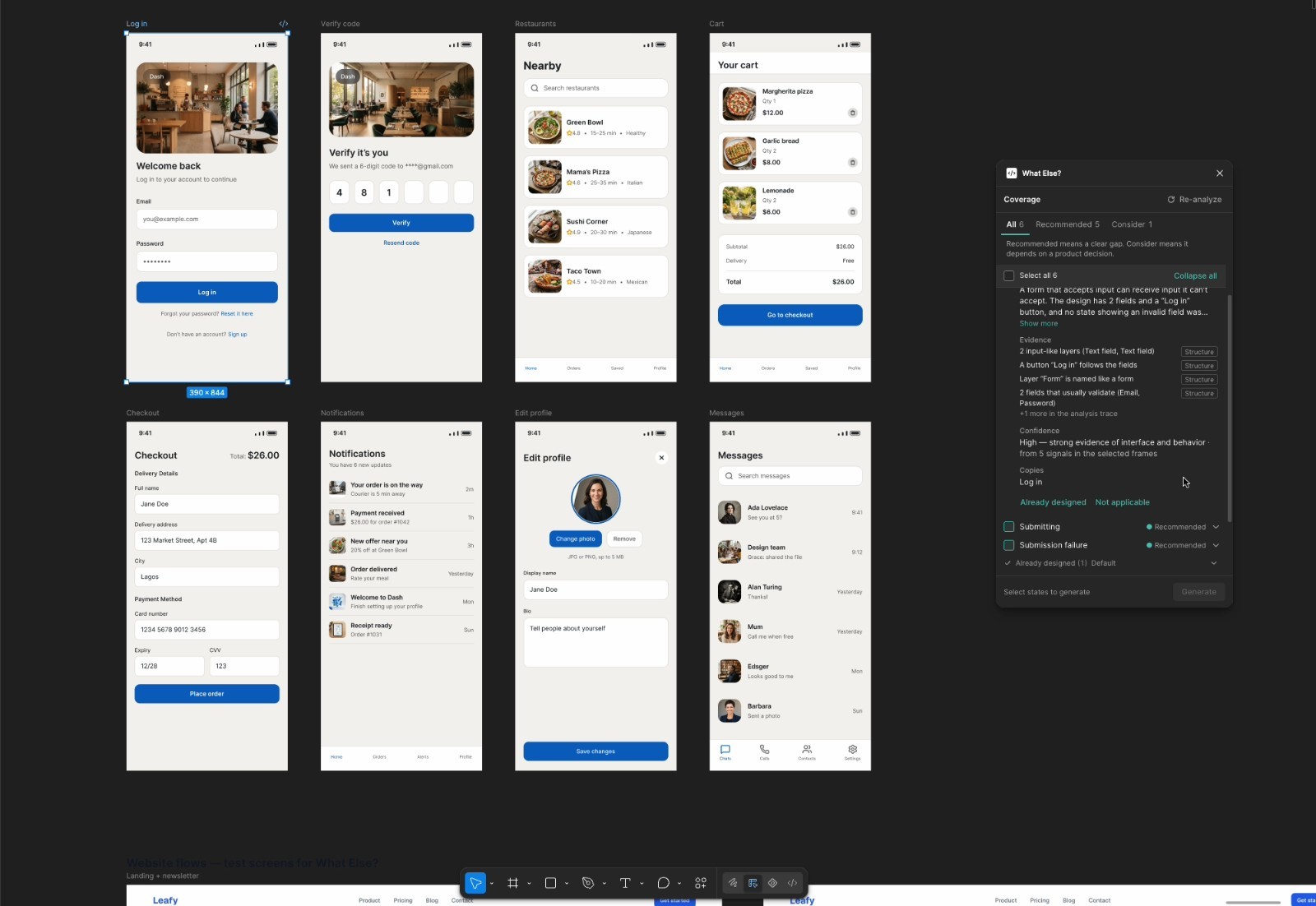
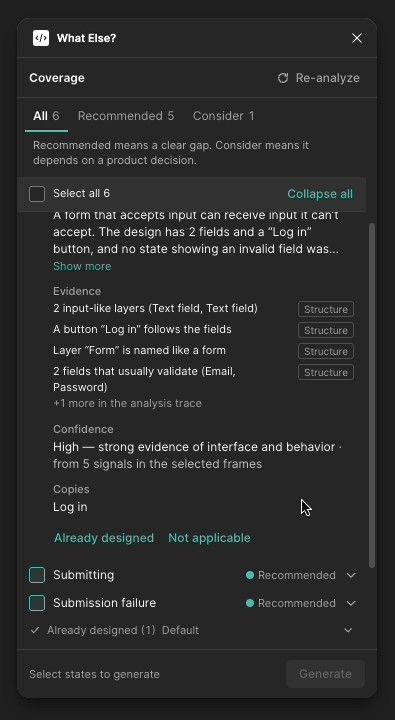
It suggests what is probably missing
Ranked by how likely each state is to matter, with a plain reason for each.
- 04
You tick the ones you want
Why, evidence and confidence sit next to every suggestion, so you decide, not the plugin.
- 05
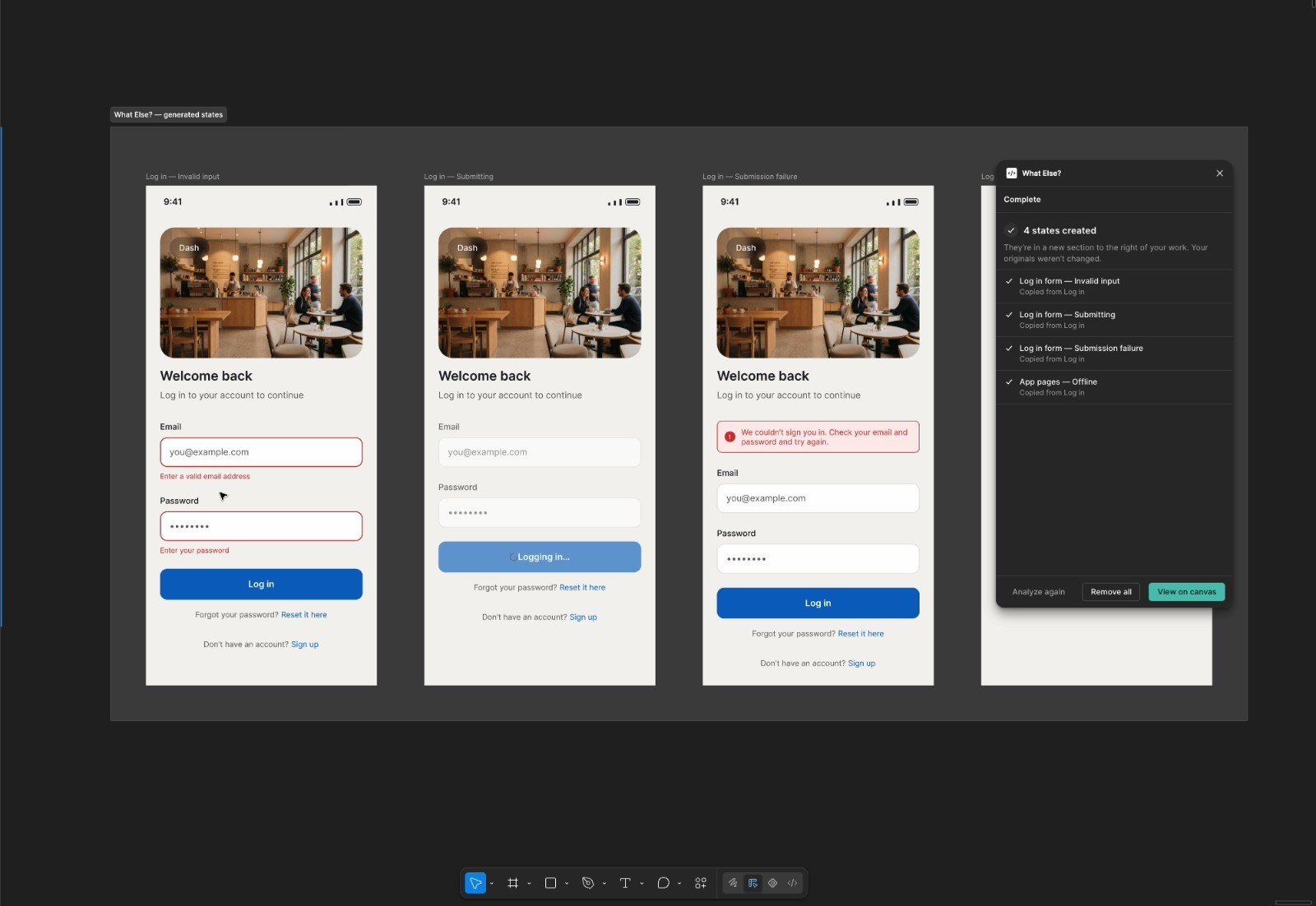
It draws them next to your work
Into a section called “What Else? generated states”. Your original frames are never touched.
No backend. Nothing leaves your file.
No AI model sitting on a server guessing. Everything runs inside Figma on rules I wrote, so it is fast, it is private, and client designs never leave the file. That was a deliberate decision, not a limitation. If you work in fintech or anything regulated, “where does my design go?” is the first question, and I wanted the answer to be “nowhere”.
What it looks like
The plugin, working on a real file.
The problem, with receipts
Before I built anything, I checked it was a real problem and not just mine.
- desk sources read
- data points pulled out
- insight clusters
- findings from walking through real products
- 01Teams design the happy path and treat everything else as “later”.
- 02The states that get forgotten are the same ones every time: empty, loading, error, success and permission problems.
- 03Forgotten states are expensive because they get discovered in build, when changing them is annoying and political.
- 04Checklists exist, but nobody opens them at 6 pm on a Thursday.
- 05The best fix happens inside the design tool, at the moment you are already looking at the screen.
13 ideas scored on effort and impact came out at 1 strategic bet and 0 quick wins. A polite way of saying nothing was going to be free. I picked the one that mattered.
How I built it, and where AI fits
AI did a lot of the typing. The thinking was mine.
I built this with AI as a pair. I did the research, the decisions on what the plugin should and should not do, the testing and the judgment on every state it generates. I don’t think of that as a shortcut. I think of it as leverage. A plugin that generates the wrong states quickly is just a faster way to be wrong.
- v1 to v3Reading frames, suggesting states, generating them from your own components, across forms, lists, search, uploads and async actions.
- v4Went out to the six testers.
- v5Fixed the bug three testers hit.
- analysis tests
- generator checks
- generated states checked by hand in real Figma
Testing with six real designers
Everyone brought their own work. Nobody tested on my samples.
kept
- 6 of 6would use it again
- 5 of 6got it working first time
- 8.4average rating
- 3 of 6hit the same bug on a login form
Ratings: 8, 8, 8, 8.5, 9, 9. Six people is six people. This is not a study with statistical weight. It is a small, honest signal from people whose opinion I trust, and “kept” means they looked at the state and decided it was worth having in their file.
The bug that taught me about real Figma
My tests were green. My plugin was broken.
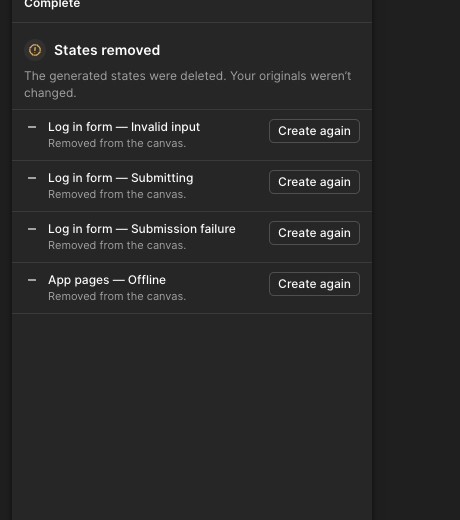
Three testers hit the same thing on a login form. The plugin tried to generate the invalid-input state and stopped with Figma’s own complaint: “Cannot move node. New parent is an instance or is inside of an instance.” It also left a stray label floating on the canvas, which is the kind of thing that makes a designer trust you a little less.
In their files the inputs were component instances, and Figma won’t let you add layers inside an instance. My test files had plain frames, so everything I tested passed. The real lesson was that my test setup was too forgiving.
The fix
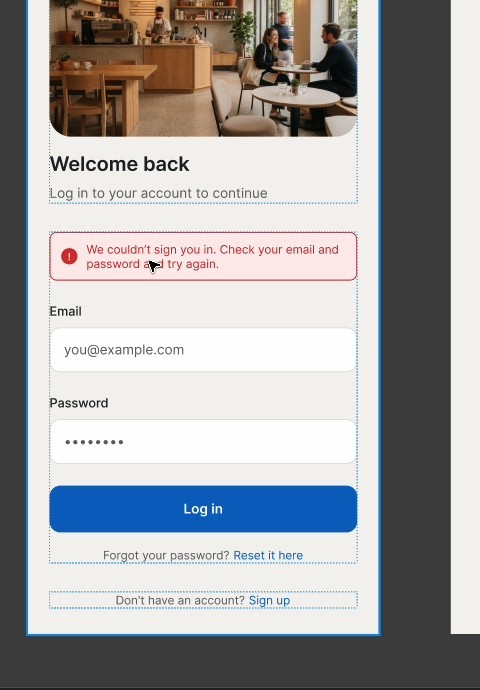
Open the instance, then add the helper text.
When a field is an instance, the plugin now detaches it first, so it looks identical, and then adds the error message. This is the invalid state that used to fail.
The safety net
If a state fails, clean up after it.
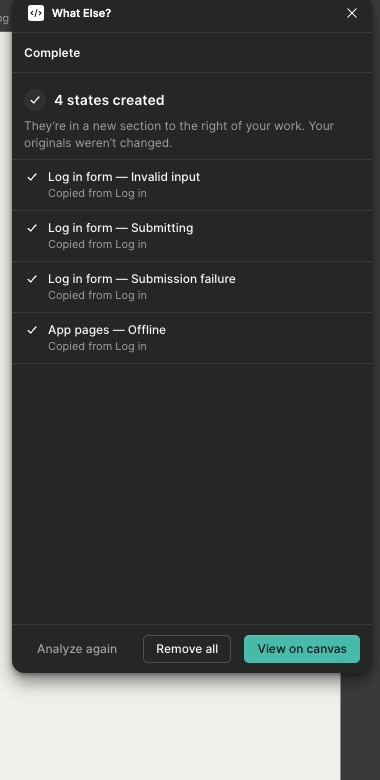
Whatever goes wrong, the plugin removes everything it created, so nobody is left with stray layers. Remove all does the same on demand.
v5
Shipped to everyone.
With a test that reproduces that exact login case, so it can’t quietly come back, and a stricter fake Figma behind my tests.
The feedback that made me go quiet
The most useful thing it taught me came from the seniors.
“I see it repeats existing components, which means consistency. But does it read my design system? That would be a huge plus.”
3 of 6 testers, all senior
“It only creates edge cases. It doesn’t create a core missing piece of the design flow.”
2 of 6 testers wanted more than states
They are right. The plugin is good at “this form has no error state”. It is not good at “this flow has no confirmation screen at all”. One is a gap in a screen, the other a gap in the journey. I could have said that was never the scope, but the scope was mine, so I wrote both into the next version’s priorities: reading the design system directly, and suggesting whole missing screens.
Honestly
What I would do differently, and what is still not done.
Differently
- Test on component instances from day one. I lost days to a bug real files would have shown immediately.
- Count the edits each generated state needed. I know 84% were kept, not how much polish they needed.
- Test with more people. Six is a start. I would like twenty.
- Ask the design system question earlier. It would have shaped version one, not five.
Not done yet
- Avatar and photo upload states
- Coloured pills inside skeleton loaders
- The partly filled boxes on a resend-code countdown
- The 403 page, which it suggests but doesn’t fully draw yet
- Reading a design system directly
- Suggesting whole missing screens
“Ask ‘what else?’ before someone else asks it for me.”
If you tried it and it did something odd, tell me. If you have a design system you would love it to read, definitely tell me. I’m still working on this one.
Save Bubi. Pick a topic to begin.

Help, I am stuck! Save me?


Save Bubi
Bubi is stuck in a cage and he is counting on you. Pick a topic and guess the word. Every wrong letter shakes the cage harder.
Pick a topic